
Higher Rates Are Back
For the week ended 9/19/26.

Well, that didn’t take long.
After spending much of the past few years debating when, and by how much, the Federal Reserve would cut interest rates, we have officially reversed course. On Wednesday, the FOMC unanimously raised its benchmark rate by 25 basis points to a range of 3.75% - 4.00%, marking the Fed’s first increase since July 2023. Perhaps more importantly, the Fed’s latest projections suggest policymakers are not necessarily finished.
Why the reversal? Inflation remains elevated, while the economy and labor market continue to show considerably more resilience than one might expect. Initial jobless claims fell to just 196,000 last week, down 10,000 from the prior week. Not exactly the type of employment data that screams for easier monetary policy.
Housing, however, continues to feel the effects of higher borrowing costs. August housing starts fell 2.6% to an annualized pace of 1.275 million units, while building permits declined 2.7% to 1.394 million. Interestingly, single-family starts actually rose 7.6%, so the headline weakness was concentrated elsewhere in the residential market.
And the Fed isn’t the only central bank tightening. The Bank of Japan raised rates again Friday, continuing a normalization process that deserves more attention than it usually receives. Why should U.S. investors care? Japanese investors are enormous holders of overseas assets. As domestic Japanese yields become increasingly competitive, repatriating even a small portion of that capital could have implications for global bond and equity markets. The days of essentially free Japanese money are clearly fading.
For the week, there wasn’t much excitement on the upside. Commodities led the pack with a whopping 0.2% return, followed by foreign bonds and cash at 0.1%. U.S. bonds were flat, domestic stocks slipped 0.1%, foreign stocks fell 1.2%, and real estate brought up the rear at -2.0%.
Far more interesting is how remarkably consistent the rankings remain over longer periods. The relative ordering of every asset class is identical year-to-date and over the trailing year.
At the top sits commodities, up an impressive 36.1% YTD and 46.0% over the past year - followed by foreign stocks and U.S. stocks. At the bottom of the barrel – yes, pun intended – are foreign and domestic bonds. U.S. bonds are down 1.5% YTD and 0.4% over the past year.
And since private credit continues to receive an almost comical amount of negative press, here's an interesting comparison. The private credit managers used here at Consilium are up roughly +1% YTD and +4% over the trailing year. That hardly looks like the financial apocalypse some headlines would have you believe. Funny how numbers can ruin a perfectly good narrative. Of course, one year does not make an investment strategy, which is precisely why diversification exists.
Looking ahead, the economic calendar mercifully quiets down a bit. Wednesday brings manufacturing and services PMI readings, while Thursday gives us new home sales and weekly jobless claims. Friday wraps things up with durable goods orders.
And with that, may your football team keep you interested past halftime. Mine failed miserably at that assignment. Cooler weather has arrived, so perhaps the better investment this week is simply getting outside.

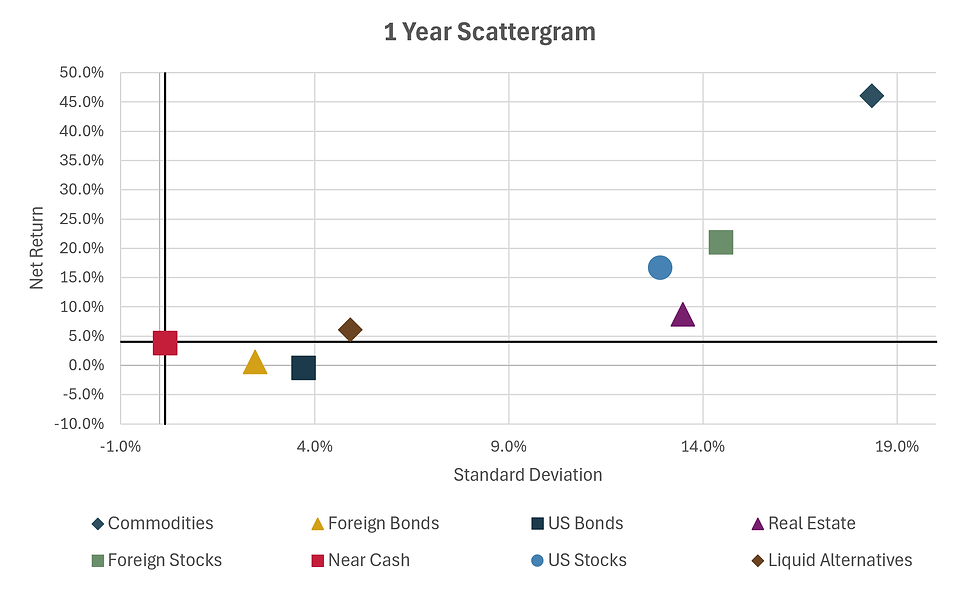

Interesting data point of the week.


Comments