
Inflation Is Back… and the Bond Market Is Officially Having a Midlife Crisis
For the week ended 5/16/26.
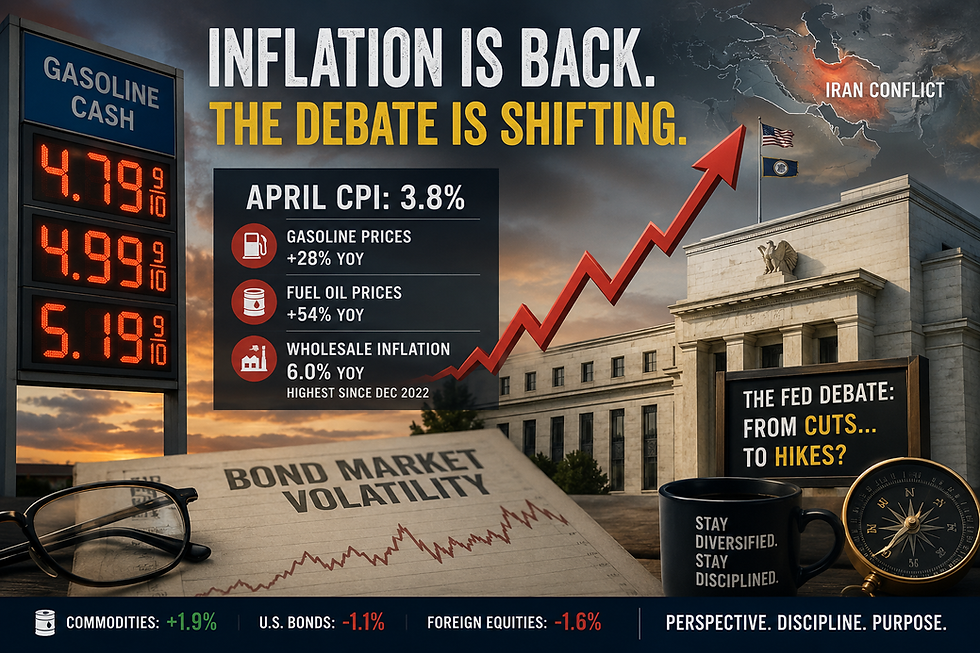
Well, so much for the “inflation is under control” narrative. April’s CPI report reminded everyone that inflation, much like a bad horror movie villain, has a nasty habit of reappearing when you least want it to.
Consumer prices rose 3.8% year-over-year in April, hotter than both March’s 3.3% reading and economists’ expectations of 3.7%. Core inflation – the Fed’s preferred “please ignore food and energy because they’re inconvenient” measure – also ticked higher to 2.8%. And yes, the elephant in the room is energy. Since the onset of the Iran conflict, gasoline prices have surged 28% while fuel oil has exploded 54%. Nothing says “good morning America” quite like paying luxury-watch prices to fill up your SUV.
Wholesale inflation wasn’t much prettier either. Producer prices climbed 1.4% in April alone, pushing the annual pace to 6.0%, the highest since late 2022. Translation: higher costs are still moving through the economic pipeline like an unwelcome Amazon delivery no one ordered.
Just a few months ago, markets were busy fantasizing about multiple Fed rate cuts in 2026 as labor markets appeared shaky. Fast forward to today and the employment picture has stabilized while inflation has reaccelerated. Suddenly, the conversation inside the Fed is no longer “when do we cut?” but rather “do we eventually need to hike again?” That’s quite the welcome basket for incoming Fed Chair Kevin Warsh, especially with a White House openly demanding lower rates. Jerome Powell may be exiting center stage, but he’s leaving behind one heck of a group project.
Meanwhile, the bond market continues to resemble a demolition derby. The 10-year Treasury yield climbed to its highest level in over a year as global government bonds sold off aggressively. U.S. bonds dropped a painful 1.1% last week, while foreign bonds fell 77 basis points. Stocks weren’t spared either, though the mega-cap dominated S&P 500 still managed to squeak out a gain of roughly 20 bps while broader U.S. equities finished slightly negative. Foreign shares fell 1.6%.
The only real winner? Commodities, up 1.9%, as geopolitical chaos continues doing geopolitical chaos things.
Looking ahead, it’s a fairly light economic week outside of Wednesday’s FOMC minutes – a document normally about as exciting as reading microwave instructions, but suddenly carrying a bit more intrigue given the inflation backdrop.
With that, may your coffee be strong, your portfolios diversified, and your gas tank at least half full before the next headline hits.


Interesting data point of the week.


Comments